


Blog
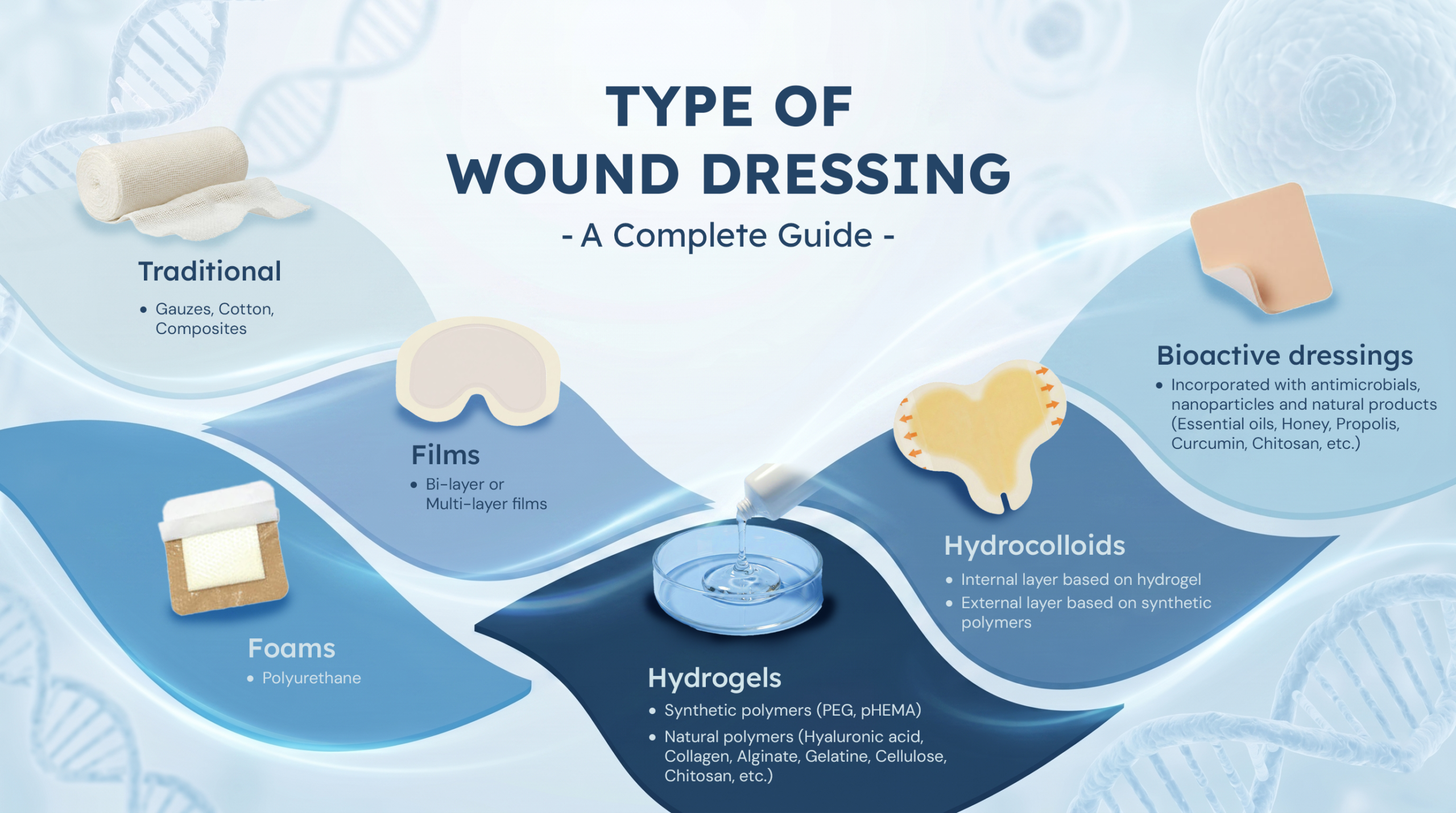
The wound requires a protective barrier to promote the healing. Early humankind employed many different materials from the natural surroundings to treat the wounds. These include natural fibers such as wool and linen, honey, etc. Continuous development results in the development of wound dressings with improved performance, which leads to the development of the modern dressing.
This guide titled as Type of wound dressings: A complete guide covers various types of dressings with brief descriptions and offers detailed explanations of modern wound dressings and their classifications.
What is Wound Dressing?
Wound, whether it is a minor cut or a major incision, it is important to care for it properly, part of this process includes wound dressing.
Purpose:
- Protection of healing wound bed
- Promotion of granulation tissue formation
- Support of autolysis to promote debridement of dead tissue
- Management of local and/or systemic infection
- Management of excessive exudate
- Malodour control
- Management of hyper-granulation
Types of Wound Dressing
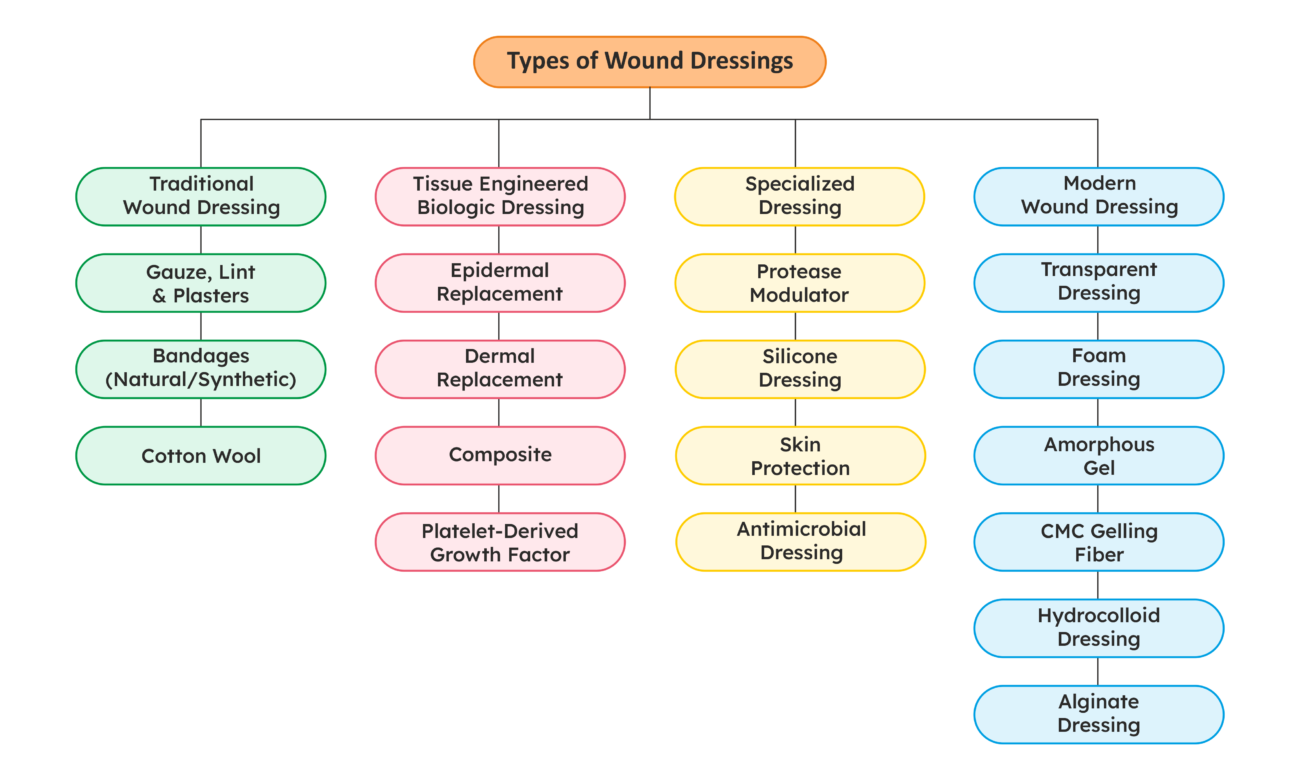
Traditional Wound Dressings absorb excessive wound moisture and fail to maintain the moist environment necessary for optimal healing. They can dry the wound surface, slow the healing process, and cause pain during dressing removal. Although they may be used alone or as part of composite dressings, their limited drainage capacity and poor moisture management have led to the development of modern wound dressings. Advanced materials such as films, foams, and hydrogels provide better absorption, semi-permeability, and moisture balance, creating ideal conditions for wound healing. As a result, modern dressings have largely replaced traditional dressings and topical formulations, especially for chronic wounds and burns.
Tissue-engineered biologic dressing increases the rate of healing when compared with traditional dressings used also with compression. Specialized dressing can be challenging to determine definition of non-healing.
In comparison with traditional wound dressing, modern ones provide the wettability of the wound surface, gas exchange to provide the wound with proper oxygen tension, insulate the wound against temperature extremes and provide a bacterial barrier, exudate absorption, are non-adhesive to the wound bed to allow the dressing to be changed with minimal trauma to the fragile and newly-formed epithelium, and are able to enhance autolytic wound debridement.
In addition, modern wound dressing accelerates the formation of granulation tissue and facilitate the migration of epithelial cells from the edges of the wound to its center. From a patient point of view, it would also be desirable to eliminate discomfort normally associated with wound dressings and allow conformation to difficult body contours.
Modern Wound Dressings
1. Hydrocolloid Dressing
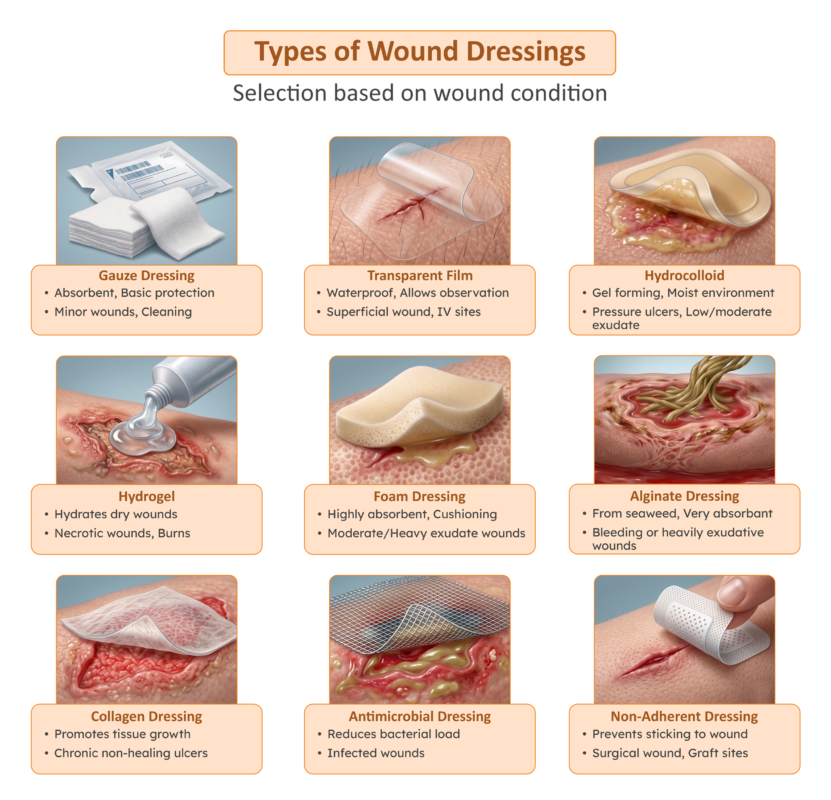
Hydrocolloid dressing (HCD) is an occlusive dressing that contains a hydrocolloid matrix (e.g., gelatin, pectin and carboxymethylcellulose) with elastomeric and adhesive substances attached to a polymer base. On contact with wound exudates, the hydrocolloid matrix absorbs water, swells and liquefies to form a moist gel. This has been claimed to expedite healing by providing a moist and warm environment at the wound surface and also by preventing external bacterial colonization.
HCDs have been promoted as an effective method for healing chronic wounds, keloids, hypertrophic scars, leg-ulcers, burns, pressure sores, diabetic wound healing. Hydrocolloid dressing designed to manage moderate to heavily exuding wounds. The application and removal of hydrocolloid dressings were easier than those of traditional gauze dressings. It did not tend to stick to the wound.
The main benefit of these dressings is the decrease in postoperative pain while the main problem with hydrocolloid dressings was leakage during the first weeks postoperatively, until the size of the wound decreased.
Leaks were a consequence of poor adherence – a problem not observed in other types of wounds – and made it necessary to change dressings more frequently than expected. It has the ability to stay in place for up to 5-7 days before they need to be changed.
If you are dealing with chronic wounds, leg ulcers, or minor burns, you need a material that locks in warmth and keeps bacteria out. ECURA Hydrocolloid interacts directly with wound fluid to form a soothing, moist gel, drastically reducing postoperative pain without sticking to the wound bed.
2. Alginate dressing
Alginate Dressing is a strong similarity to cellulose with the alcohol functions replaced by carboxyl groups. In contact with body fluids, alginate dressings undergo an ion-exchange reaction in which calcium ions from the alginate are replaced by sodium ions present in blood and wound exudate, resulting in the formation of a soft, non-adherent gel at the wound surface that helps maintain a moist wound-healing environment.
During this process, free calcium ions are released, contributing to haemostasis by providing an essential factor in the clotting cascade. The wound exudate converts the calcium alginate to its sodium salt, facilitating dissolution and easy removal of the dressing. Any residual fibers remaining within the wound are biodegradable and are broken down into simple monosaccharide residues that are completely absorbed, thereby eliminating the need for complete removal. The gel formed is non-toxic and fully biodegradable.
Alginate dressings are most suitable for moderately to heavily exuding wounds but less so for wounds producing limited amounts of wound exudate, split skin graft donor site and pressure ulcer.
The main advantage over traditional cotton gauze and similar materials is that alginate dressings provide a moist wound gel environment which promotes epithelialization.
Alginate dressings have the advantages of rapid absorption and less skin maceration while a disadvantage with alginate dressings is that the material can be incorporated in the developing granulation tissue if unsaturated with wound fluid.
Although alginate materials are claimed to be biodegradable, these materials are resorbed very slowly and have been reported to cause foreign-body reactions if left for prolonged periods in tissues. Alginate dressing can be changed daily or at least every four to seven days.
Highly exuding wounds require heavy-duty absorption to prevent the surrounding skin from softening and breaking down. ECURA Alginate Dressing utilizes natural, biodegradable fibers that transform into a soft gel upon contact with body fluids, speeding up the healing process.
3. Foam dressing
Foams are generally made from polyurethane that has been heat-treated to provide a smooth contact surface. There are many foam dressings available today, all of which can absorb exudate in various ways. Many foams absorb exudate into the foam; some have the capacity to wick horizontally, thus increasing absorbency of fluid as it spreads through the whole dressing.
Some foams are able to breathe off the moisture that they absorb through a permeable backing. This increases the capacity of the dressing, and is referred to as the moisture vapour transfer rate (MVTR). The foam dressing must be efficacious in absorbing and retaining wound exudate to prevent maceration of peri wound skin.
Foams dressings can be used as a primary or secondary dressing on a variety of wound types. They are suitable for shallow wounds and there are some foam dressings suitable for cavity wounds. Foams dressings are also suitable to cover wounds that have been lightly packed with a ribbon preparation.
Foams dressings can be used on Leg ulcers and under compression therapy, pressure ulcers, traumatic wounds, gastrotomy and tracheostomy wounds, minor burns, skin grafts, donor sites, diabetic ulcers, all wounds where exudate present.
Foam dressings continue to be important in wound care and have a place for the treatment and management of chronic wounds, particularly where exudate is problematic. Foam dressings are not suitable for necrotic and dry wounds.
Foam dressings are not licensed as pressure relieving. Foams can be used to protect vulnerable skin, but if the skin is covered by a foam dressing it can hide any deterioration unless removed frequently for observation, especially in the case of pressure damage. Foam dressing specifically provide thermal insulation, do not shed fibers or particles, are easily cut or shaped and help to maintain a moist environment at the surface of the wound.
They are also gassing permeable, non-adherent, light and comfortable to wear and, in some cases, they are able to absorb significant volumes of exudate. Foams can be left in situ for 3-7 days and will need to be changed dependent on the level of exudate present.
For deep or problematic chronic wounds, foam provides crucial thermal insulation and massive fluid retention. Options like ECURA Polyurethane Foam Dressing wick heavy drainage horizontally across a breathable backing, while the ultra-gentle ECURA Silicone Foam Dressing conforms perfectly to difficult body contours for maximum patient comfort.
4. Film dressing
Film dressings are waterproof yet permeable to oxygen and water vapor which help in preventing bacterial contamination. It maintains a moist wound environment by controlling the moisture vapor transmission from the wound through the film, facilitate cell migration and encourage tissue autolysis by trapping moisture on the surface of the wound. Products like ECURA Transparent Dressing provide a thin, comfortable, and waterproof barrier that lets your skin breathe, while ECURA IV Securement Dressing is engineered specifically to protect and hold peripheral or central venous catheters safely in place.
Film dressings permit continuous inspection of the site and are more comfortable than conventional bulky gauze and tape. The polyurethane layer is moisture and gas permeable; this helps prevent the accumulation of moisture in the wound, so reducing the risk of tissue maceration. Film dressings are thin and tend to be very conformable to the wound site so they can be used on difficult-to-dress areas.
Film dressings are used in the treatment of a large variety of wound types, for example, superficial burns, skin grafts and surgical wounds. Securement dressings are used for Peripheral Intravenous catheter, central venous catheter, arterial catheter, etc.
A major benefit of film dressings is that they are transparent; this enables clinicians to monitor wounds without having to remove the dressings, reducing the risk of infection, trauma and pain during dressing change.
The film dressings do not stick to moist wounds, but can reinjure dry tissue during removal.
The transparency of film dressing may be less appealing to the patient who would rather not see the wound. A film layer is actually combined with an absorbent pad, although in these cases transparency is lost. It’s better to leave the film dressing on the insertion site of a central venous line for up to 7 days before replacing it.
5. Hydrogel
Hydrogels consist of a matrix of insoluble polymers with up to 96% water content. Hydrogel donates water molecules to the wound surface and maintain a moist environment at the wound bed. As the polymers are only partially hydrated, hydrogels have the ability to absorb a degree of wound exudate. They transmit moisture vapour and oxygen, but their bacterial and fluid permeability is dependent on the type of secondary dressing used. Hydrogels promote wound debridement by rehydration of non-viable tissue, thus facilitating the process of natural autolysis. Utilizing ECURA Hydrocolloid or ECURA CMC Dressing Varieties to establish a protective barrier, dry tissue requires direct rehydration to heal. Incorporating ECURA Amorphous Wound Gel or ECURA Hyaluronic Acid Gel successfully donates essential water molecules to the wound surface, accelerating natural autolytic debridement and offering immediate cooling pain relief.
They are not indicated for wounds producing high levels of exudate or where there is evidence of gangrenous tissue. They provide moisture, maintain an environment conducive to cell migration and thus, offer a cooling effect to reduce pain.
6. Gauze
Unlike traditional gauze dressings that may adhere to the wound bed and cause pain during removal, CMC Soluble Hemostatic Gauze is highly biocompatible and minimizes tissue trauma. Its ability to maintain a moist wound environment supports cell migration and tissue regeneration, which are essential for efficient healing. The dressing also helps manage exudate effectively, reducing the risk of wound maceration and improving patient comfort.
CMC Soluble Hemostatic Gauze represents a significant advancement in modern wound care and bleeding management. Manufactured from sodium carboxymethyl cellulose (CMC), this absorbable dressing is designed to rapidly control bleeding while creating an optimal environment for wound healing. Upon contact with blood or wound exudate, the gauze absorbs fluid and transforms into a soft gel-like layer that helps promote clot formation and provides a protective barrier over the wound.
Due to its excellent hemostatic properties, high absorbency, and ease of application, ECURA CMC Soluble Hemostatic Gauze is widely used in surgical procedures, dental treatments, trauma care, and post-operative wound management. Its combination of rapid bleeding control and wound-healing support makes it a valuable solution for healthcare professionals seeking effective and patient-friendly wound care options.