



Blog

The Skin is the body’s first line of defense, acting as a natural shield against physical damage, harmful chemicals, and invading microbes. Wounds are injuries that disrupt the normal structure of tissues and can impair their function. They can result from a variety of causes, such as cuts, burns, surgical procedures, or underlying medical conditions.
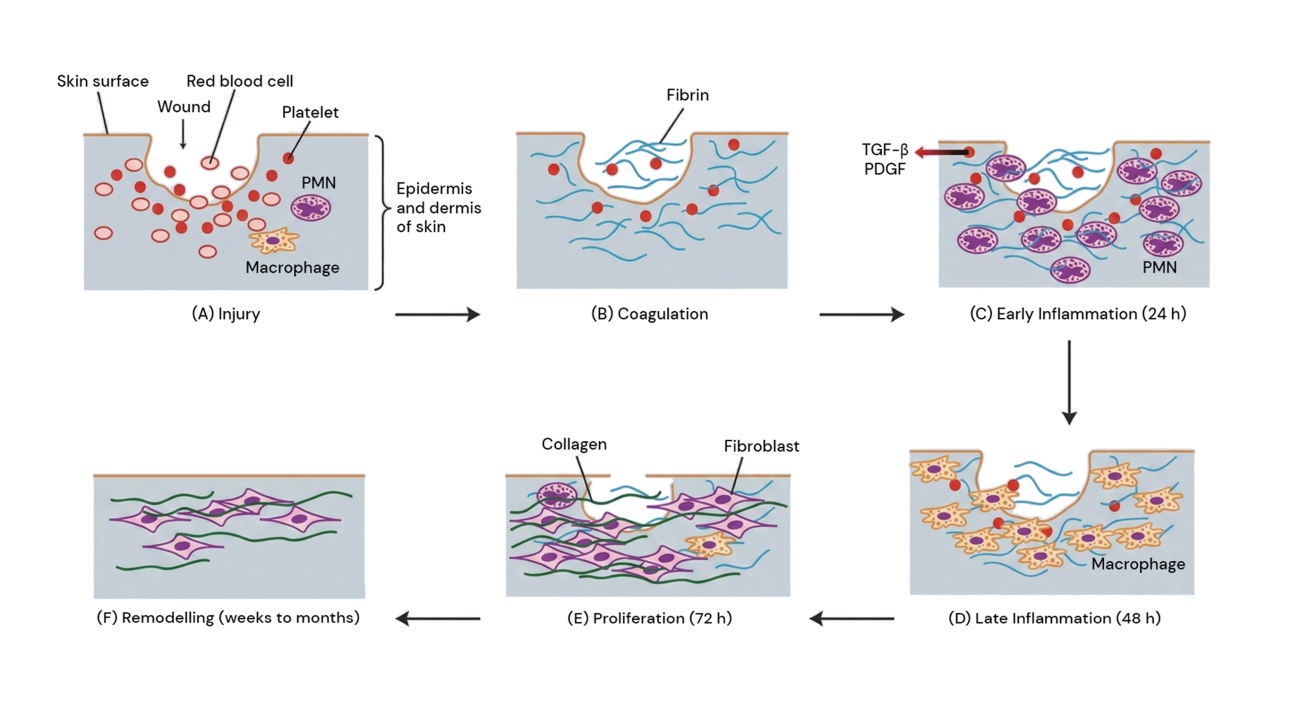
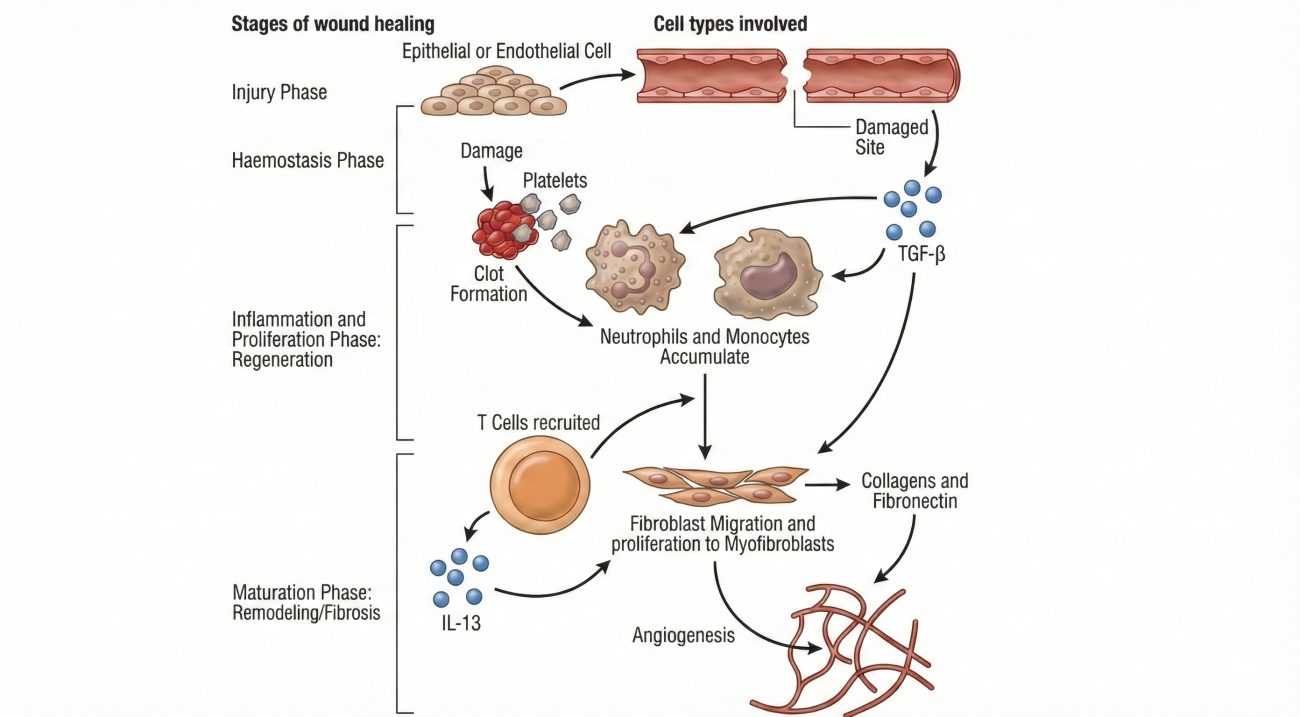
While Wound Healing, we usually refer to the repair process of the skin, the body’s first line of defense. This process begins immediately after an injury, triggering a complex series of events that involve blood clotting (Hemostasis), inflammation, tissue formation (Proliferation), and remodeling. While the initial stages may occur within hours or days, complete healing can take weeks, months, or even longer depending on the severity and type of wound, as well as overall health. In every phase, wound healing depends on the combined action of cells at the wound site, signaling molecules, and the surrounding extracellular matrix working together to repair the tissue.
There are two basic types of wound healing.
Healing by first intention
It happens in clean uninfected clear-cut margins as surgically incised wounds without much loss of cells and tissue and in wounds where the edges are approximated. Primary intention involves the smooth healing of a clean wound with little tissue loss, where the skin edges are neatly aligned ex. surgical cuts.
Healing by secondary intention
Secondary intention healing occurs when complications like infection, poor oxygen supply, immune dysfunction, or wound edge separation interfere with normal repair. In this process, granulation tissue forms and new skin gradually covers the wound. These wounds usually heal more slowly, are at higher risk of infection, and often result in less favorable cosmetic outcomes and reduced tissue strength .
PHASES OF WOUND HEALING
Hemostasis: Immediate Control and Wound Stabilization
Hemostasis is the earliest and shortest stage of wound healing and body’s immediate response to injury to stop bleeding and begin the healing process. Known as the pro-inflammatory phase, it involves mechanisms that halt blood flow at the injury site. The term “hemostasis” comes from the Greek words hemo, meaning blood, and stasis, meaning to stop, accurately describing its function.
Hemostasis occurs through four well-defined stages. First, the damaged blood vessel constricts to reduce blood flow. This is followed by the rapid formation of a temporary platelet plug as platelets adhere to the injury site and activate one another. Next, the coagulation cascade is triggered, activating a series of clotting factors that reinforce the platelet plug. Finally, a stable fibrin clot forms, creating a strong seal that stops bleeding and provides a framework for wound healing.
Beyond controlling blood loss, this final fibrin network plays a key role in tissue repair. Its structure supports cell migration, new blood vessel formation, and regeneration of damaged tissue, making hemostasis not only essential for survival but also for effective healing.
However, hemostasis can be compromised in traumatic wounds, surgical sites, or patients with impaired clotting. Inadequate bleeding control can destabilize the wound environment and delay further healing.
Chitosan based products such as ECURA Chitosan Hemostats, ECURA Chitosan Gauze, & others etc. are widely used in hemostatic wound care because of its natural positive charge and excellent biocompatibility. When it contacts blood, it attracts platelets and red blood cells, absorbs moisture, and forms an adhesive layer that seals the wound. This rapid clot-forming action makes chitosan- based dressings highly effective for controlling bleeding in clinical practice.
Carboxymethyl cellulose (CMC)-based wound dressings such as ECURA Soluble Hemostatic gauze is increasingly studied due to their high fluid absorption, formation of a gel barrier at bleeding sites, and facilitation of blood cell aggregation and clotting, which supports rapid hemostasis and early wound stabilization in acute and surgical wounds.
Inflammation: Defense, Cleaning, and Early Healing
Once hemostasis halts the bleeding, the inflammation phase begins, signaling the body to activate its defense response and initiate the healing process. As blood flow increases and blood vessels become more permeable, inflammatory cells are able to travel more easily to the wound site to support healing. During the inflammation phase, the body moves from stopping blood loss to defending and repairing the wound. Blood vessels first narrow to control bleeding, then widen to let white blood cells, antibodies, and nutrients reach the injured area. This process often causes redness, warmth, swelling, and mild pain—clear signs that healing is underway.
It resembles a well-coordinated military mission, with the body’s defense cells quickly mobilizing to the injury site to begin the healing process. Neutrophils act as the first responders, attacking bacteria, while macrophages follow to clear damaged tissue and debris. Together, they protect the wound from infection and prepare it for repair. These cells release signals that encourage new blood vessel growth and tissue formation, allowing fibroblasts and skin cells to rebuild healthy tissue and move the wound toward recovery.
While inflammation is essential, it must remain controlled. Excessive or prolonged inflammation, often caused by infection or repeated trauma, can slow healing and increase the risk of chronic wounds.
During this phase, wound care typically focuses on:
- Protecting the wound from microbial contamination
- Managing exudate without drying the tissue
- Preventing further mechanical irritation
Dressings that provide antimicrobial protection and effective exudate management such as ECURA Chitosan Wound Dressings, ECURA CMC Gelling Fiber, ECURA Hydrocolloid Dressing, ECURA Silicone Foam Dressings, and ECURA PU foam dressings can help maintaining a clean and balanced wound environment, allowing inflammation to resolve naturally.
Proliferation: Tissue Formation and Wound Closure
Once inflammation fades, the proliferative phase takes over, marking a vital stage of wound healing in which new blood vessels form, fresh tissue develops, and the wound surface is rebuilt through re-epithelialization. The proliferative phase typically begins around 3–4 days after an injury and can continue for up to 10–14 days or longer, depending on the severity of the wound and the body’s healing response. Activated macrophages play a key role in healing by signaling fibroblasts to rebuild tissue and encouraging the formation of new blood vessels. The wound transforms into a healing-friendly environment as macrophages shift from a defensive role to a regenerative one, producing factors that reduce inflammation, stimulate new blood vessel growth, and promote tissue regeneration. In the proliferative phase, growth factors activate essential cells such as fibroblasts, keratinocytes, and endothelial cells, promoting matrix formation, blood vessel growth, and successful wound closure.
Hydrogels & Hydrocolloids: Maintain a moist environment crucial for cell migration (keratinocytes) and allow for autolysis, which helps in preparing the wound bed. Foam Dressings are effective for wounds with high exudate, keeping them moist without maceration.
ECURA Amorphous Wound Gels (including Chitosan- and Hyaluronic Acid-based formulations), ECURA Hydrocolloid Dressings, and ECURA Silicone Foam Dressings, which helps to preserve hydration, provide cushion to the wound, and promote uninterrupted tissue growth.
Remodeling or Maturation Phase: Strengthening and Long-Term Stability
The final phase of wound healing, called remodeling or maturation, begins around three weeks after injury and can continue for months or even up to a year, completing the repair process. During the remodeling phase, granulation tissue formation comes to an end, and the wound begins to strengthen and mature, During the remodeling phase, disorganized collagen type III is gradually replaced by stronger, well-aligned collagen type I, increasing the wound’s strength as matrix remodeling enzymes refine the tissue and the remaining cells from earlier healing phases undergo apoptosis, although the repaired skin never fully matches the structure of healthy tissue. At the end of healing, blood vessel growth slows, circulation returns to normal, and the wound closes with scar tissue that regains roughly 80% of the skin’s original strength but lacks normal skin structures such as hair follicles and sweat glands.
ECURA Transparent film dressings, ECURA Silicone-based foam dressings, and other mechanical protective dressings are often used to safeguard the wound during this final stage and support healthy scar formation.
Healing involves a step-by-step repair process, from stopping blood loss to rebuilding tissue and forming a scar. While repaired skin may not be identical to the original, knowledge of these phases supports better care and recovery.
We at EonCure have a broad portfolio of wound dressings which supports each and every stage in wound healing.
References:
- Massoud, D. et al. Aloe vera and wound healing: a brief review. Brazilian Journal of Pharmaceutical Sciences 58, (2022).
- Ozgok Kangal MK, Kopitnik NL. Physiology, Wound Healing. StatPearls Treasure Island (FL): StatPearls Publishing; Jan (2025). https://www.ncbi.nlm.nih.gov/books/NBK535406
- Nanomaterials for Wound Healing. http://taylorandfrancis.com.
- Abazari, M., Ghaffari, A., et al. Y. A Systematic Review on Classification, Identification, and Healing Process of Burn Wound Healing. International Journal of Lower Extremity Wounds 21 18–30, (2022) https://doi.org/10.1177/1534734620924857.
- Roberta Cassano, Paolo Perri, et.al., Chitosan Hemostatic Dressings: Properties and Surgical Applications Polymers (2024), 16(13), 1770; https://doi.org/10.3390/polym16131770
- Vimala Kanikireddy, Kokkarachedu Varaprasad, et al. Carboxymethyl cellulose-based materials for infection control and wound healing: International Journal of Biological Macromolecules Volume 164, 1 December (2020), Pages 963-975. A review https://doi.org/10.1016/j.ijbiomac.2020.07.160
- Priscila Schilrreff and Ulrike Alexiev. Chronic Inflammation in Non-Healing Skin Wounds and Promising Natural Bioactive Compounds Treatment. International Journal of Molecular Sciences. (2022), 23, 4928. https://doi.org/10.3390/ijms23094928